



Key Takeaways
- •Pure AI output has no copyright. In Thaler v. Perlmutter the D.C. Circuit held human authorship is a bedrock requirement, and the Supreme Court denied review on March 2, 2026. A machine cannot be an author, so the raw output of a prompt sits in the public domain the moment it is created.
- •Because copyright may not attach, contract becomes the only enforceable ownership vehicle. An AI content ownership agreement assigns the rights, the files, the prompts, and any human-edited derivatives by contract, which binds the parties even where no copyright exists to register.
- •Platform terms will not settle ownership for you. OpenAI assigns output to the user, Midjourney grants paying subscribers a license but bars copyright claims on unedited output, and Adobe Firefly positions its output as commercially safe. None of these resolve ownership as between you and a contractor or employee.
- •Work made for hire under 17 USC 101 is the cleanest path to employer or client ownership, but commissioned AI work needs a signed writing and must fit one of nine statutory categories. Get the writing wrong and the creator keeps the rights.
- •Training-data infringement is a separate, uninsured risk. Thomson Reuters v. Ross rejected fair use for AI training on copyrighted headnotes, and Anthropic settled the Bartz class for at least $1.5 billion. Most vendor indemnities cover output, not the data the model was trained on.
- •Reviewed by the document.com legal team. Educational information, not legal advice. Verify current law for your jurisdiction before you rely on any clause here.
Reviewed for accuracy by the document.com legal team. Educational information, not legal advice.
What Is AI Content Ownership Agreement?
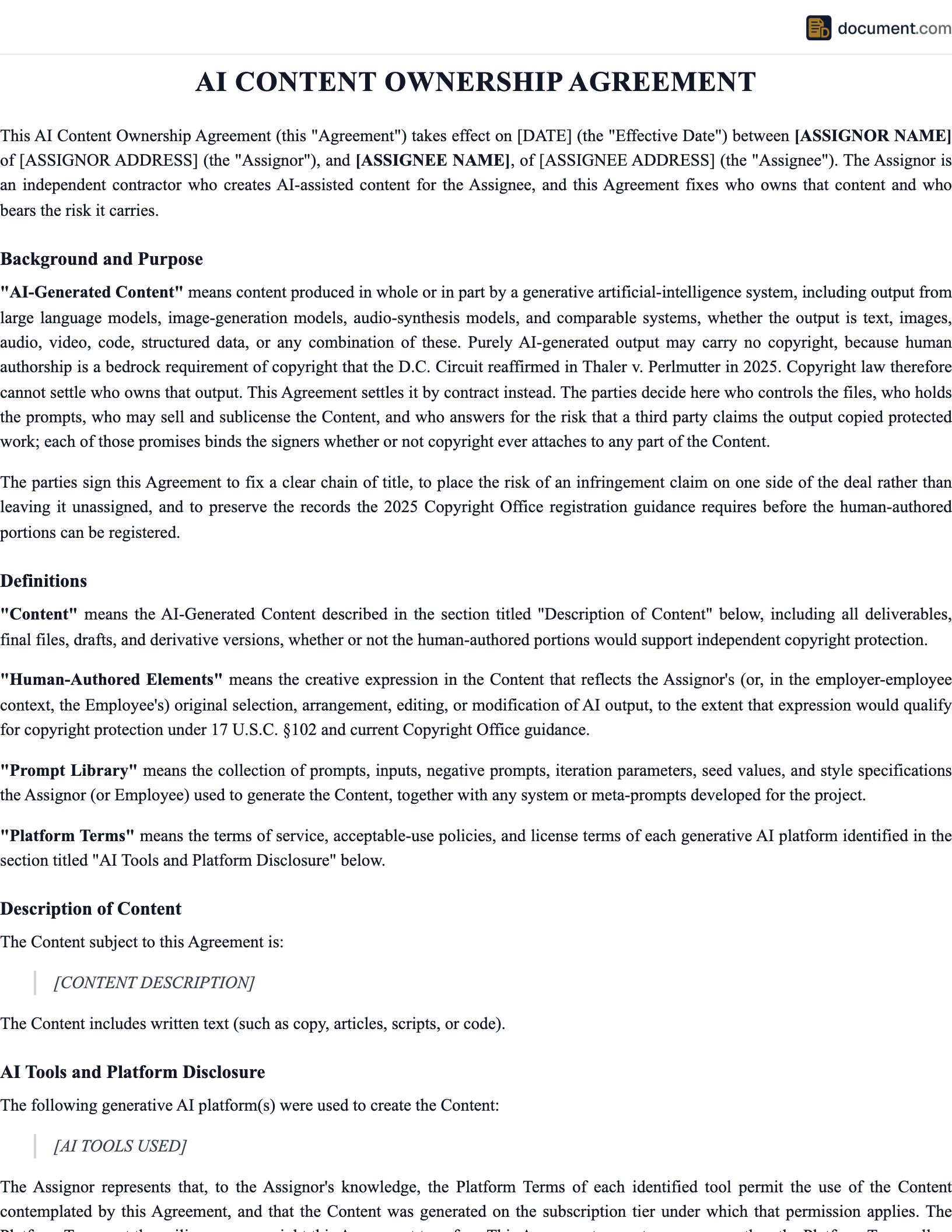
An AI content ownership agreement is a written contract that assigns the rights in AI-generated content, the underlying prompts and inputs, and any human-edited versions to a named party, and that allocates the risk if the output turns out to infringe someone else's copyright. It exists because the default rules leave a hole. When a person generates an image or a block of text with a tool like ChatGPT, DALL-E, or Midjourney, the raw output is not protected by copyright at all, so there is no copyright to transfer in the usual way.
The agreement closes that hole with contract law instead of copyright law. Even when no copyright attaches to the machine output, the parties can still agree, in writing, on who controls the files, who may sell or sublicense them, who keeps the prompt library, and who eats the loss if a third party claims the output copied their protected work. Those promises are enforceable between the signers regardless of whether the Copyright Office would ever register the result.
The classic setting is a freelance engagement: the freelancer produces marketing copy with AI assistance, and the hiring company wants to own the result. Employers use it too, to confirm in writing that AI-assisted work their staff produce belongs to the business. And a buyer who licenses or commissions AI-generated art or music relies on it for a clean chain of title and a warranty that the work does not infringe. In each case the platform's own terms of service answer only part of the question, and a separate agreement answers the rest.
Why This Matters Now
The legal ground shifted hard in 2025 and 2026. On March 2, 2026 the Supreme Court denied certiorari in Thaler v. Perlmutter, leaving the D.C. Circuit's ruling as binding law: an artificial intelligence system cannot be the author of a work, and a work created with no human involvement gets no copyright. Dr. Stephen Thaler had named his DABUS system as the sole author of an image called 'A Recent Entrance to Paradise.' The Office refused registration, and every court that looked at it agreed.
The Copyright Office spent the year building out what that means in practice. Its January 29, 2025 Part 2 report on copyrightability concluded that detailed prompts alone are not enough, because the user does not control the expressive details the model fills in. A separate 2025 registration policy now requires applicants to disclose AI-generated material and identify the human-authored portions in the application. Leave that out and your registration can be cancelled.
Money started moving at the same time. In September 2025 Anthropic agreed to pay authors at least $1.5 billion, roughly $3,000 per book across about 500,000 books, to settle claims that copyrighted books were used to train its Claude model. Earlier in 2025 a federal court in Delaware held in Thomson Reuters v. Ross that copying protected legal headnotes to train a competing AI tool was not fair use. Those cases put a dollar figure on getting AI content rights wrong.
Buyers and platforms reacted. Microsoft and Google now offer enterprise customers IP indemnities for AI output, Adobe markets Firefly as trained only on licensed content, and insurers have repriced AI-related IP coverage upward by several hundred percent. The contract you sign around AI content is now where the real allocation of these risks happens.
The Legal Backbone
Thaler v. Perlmutter: a machine cannot be an author
This is the case that frames everything else. Dr. Stephen Thaler tried to register a visual work generated by an AI system he calls DABUS, listing the machine as the sole author and himself as the claimant. The Copyright Office refused, the district court agreed, and in March 2025 the U.S. Court of Appeals for the D.C. Circuit affirmed, holding that human authorship is a bedrock requirement of copyright. District Judge Beryl A. Howell had put it plainly below: the Office acted properly in denying registration for a work created absent any human involvement. On March 2, 2026 the Supreme Court denied certiorari, so the D.C. Circuit ruling stands. If a human did not contribute the creative expression, there is no copyright to own, no matter how valuable the output is. That is exactly why a contract is needed to control content that copyright will not.
17 USC 101 and 201(b): the work-made-for-hire doctrine
Section 101 of the Copyright Act defines a 'work made for hire' in two ways. The first covers a work prepared by an employee within the scope of employment. The second covers certain specially ordered or commissioned works, but only if the parties sign a written agreement saying it is a work for hire and only if the work falls within one of nine listed categories, such as a contribution to a collective work, a translation, a compilation, instructional text, or a supplementary work. Section 201(b) then makes the employer or commissioning party the author and owner from the start. The practical consequence: when your employee produces AI-assisted material on the job, you likely own it automatically, but when you hire an outside contractor, you need that signed writing, or the contractor keeps whatever rights exist. A back-up assignment clause covers the gap where the work does not fit one of the nine categories.
The 2025 Copyright Office disclosure rule
Under the Office's 2025 registration guidance, anyone registering a work that contains AI-generated material must disclose it and identify the human-authored portions, typically by describing the human contribution and disclaiming the AI-generated parts in the application. This is not optional housekeeping. An applicant who fails to disclaim AI content faces cancellation of the registration and gives any future opponent a ready-made argument that the registration is invalid. The guidance applies to new applications and reaches back to existing registrations that should have disclosed. A good ownership agreement requires the human author to keep records of the prompts, the iterations, the edits, and the timeline, because that record is what supports the disclosure and the claim to the human-authored layer.
Thomson Reuters v. Ross and the training-data line
In February 2025, Judge Stephanos Bibas of the District of Delaware ruled that Ross Intelligence's use of Thomson Reuters' Westlaw headnotes to train a legal-research AI was not fair use. On the first fair use factor, the court found the use commercial and not transformative, because Ross took the headnotes to build a directly competing product. On the fourth factor, market harm, the court held that harm to a potential licensing market counts even if Thomson Reuters was not yet selling that license. The case is the first U.S. ruling to treat training a model on copyrighted material as infringement, and it matters for ownership agreements because the party that deploys an infringing model can be on the hook. That is why these agreements separate output risk from training risk and why most vendor indemnities quietly exclude the training-data claim.
What platform terms of service can and cannot give you
Each major platform answers the ownership question differently, and none of them resolve it between you and a third party. OpenAI assigns the output of ChatGPT and DALL-E to the user and permits commercial use, though no copyright attaches to the pure AI portion. Midjourney grants paying subscribers a broad commercial license but cannot give you copyright in unedited output, because Thaler bars that, and its free-trial users get no commercial rights at all. Adobe Firefly trains only on Adobe-owned or licensed content and markets its output as safe for commercial use, with copyright indemnity available on enterprise plans. Microsoft Copilot and Google's Vertex AI offer the broadest enterprise indemnities, with Google running a two-part model that covers both its training data and your prompted output. An ownership agreement should require each party to disclose which tools were used and on what terms, because the platform license is the foundation the contract builds on.
Copyright ownership versus contractual ownership: why this document exists
Start with the gap, because the whole document is built around it. Copyright is the right to stop other people from copying a work. It arises automatically when a human creates original expression, and once it exists you can assign it, license it, and register it. Contractual ownership works differently. It is a set of promises between the people who signed: I will treat these files as yours, I will not compete with you using them, I assign whatever rights do exist. Most of the time the two overlap so completely that nobody notices the difference. With AI-generated content they come apart, and that is the problem this agreement solves.
When a person types a prompt into an image or text generator, the model produces output by filling in expressive choices the user did not specify. Under the 2025 Copyright Office Part 2 report and the Thaler line of cases, that means the human did not author the work in the copyright sense, so no copyright attaches to the raw output. There is nothing to register and nothing to assign under copyright law. The output sits in a strange place: valuable, usable, sellable, and yet unowned in the way a photograph or a painting is owned.
Contract law does not care that copyright is missing. Two parties can still agree that one of them controls the files, holds the prompt library, may sell and sublicense, and will not be undercut by the other party reusing the same output. Those promises bind the signers even though no court would ever issue a copyright registration for the work. This agreement is built on exactly that. Where copyright supplies nothing, the contract itself creates an ownership position a court will enforce against the other signer.
The agreement also captures the part that copyright can still protect. When a human takes raw AI output and does real creative work on it, substantial editing, original arrangement, selection that shows judgment, or weaving the AI element into a larger human-made piece, that human contribution can carry its own thin copyright. The Allen v. Perlmutter case, where Jason Allen used more than 600 Midjourney prompts plus manual edits on his work 'Theatre D'opera Spatial,' is testing exactly where that line falls. Summary judgment briefing wrapped up with a reply filed in January 2026, and the outcome is not yet decided. A careful agreement does not bet on the answer. It assigns both layers: the contractual rights in the machine output, and any copyright in the human-authored modifications, so the buyer is covered whichever way the court lands.
Then there is the risk side. Owning the content does not mean the content is safe to use. If the model was trained on someone else's protected work, or if the output reproduces a recognizable copyrighted element, the person who publishes it can be sued. Most free templates never mention training data, even though that is the exposure a buyer most needs the contract to allocate. The ownership agreement allocates that risk on purpose: the creator warrants the output does not knowingly infringe, agrees to disclose the AI tools and their terms, and indemnifies the buyer for infringement claims, usually with a carve-out that the indemnity does not reach claims based on how the model was trained. That carve-out tracks the market, because vendors like Google and Microsoft will stand behind output but draw a hard line at the training data, which is precisely the claim that produced the Thomson Reuters ruling and the $1.5 billion Anthropic settlement.
One more practical layer: the disclosure obligation. Because the 2025 registration rule requires identifying human-authored portions, the agreement should force the creating party to keep contemporaneous records of prompts, iteration counts, edits, and timestamps, and to hand them over. That paper trail is what lets the owner register the human-authored layer honestly, defend it if challenged, and avoid the cancellation risk that comes with a silent or false application.
When You Need This
You hired a freelancer or agency to produce content and they used AI to make it. The freelance contract probably assigns 'the work,' but it likely says nothing about prompts, training tools, or the fact that the AI portion has no copyright. Pair this with your freelance contract so the assignment actually reaches what was delivered.
You run a business and want written confirmation that AI-assisted work your employees create belongs to the company. Employee output is often work made for hire by default, but an explicit clause plus a record-keeping requirement removes the argument and supports any future registration.
You are buying or commissioning AI-generated art, music, voice, or written content and need a clean chain of title plus a warranty that the work does not infringe. The seller cannot give you copyright in the pure AI portion, so you want a contractual transfer of control and an indemnity instead.
You are selling AI-generated content and want to define exactly what the buyer gets: a license, an assignment of the human-edited layer, or full control, and what you are not warranting, especially around training data.
You intend to register the human-authored portion of an AI-assisted work with the Copyright Office and need the creator to preserve the prompt and edit history that the 2025 disclosure rule effectively requires.
You are putting AI usage rules in place across your organization and want the content-ownership piece to sit alongside a written policy. The agreement governs deliverables, the policy governs day-to-day tool use.
How to Fill Out AI Content Ownership Agreement
1. Identify the parties and the work
Name the assignor (the person or entity creating the content) and the assignee (the person or entity that will own it). Describe the AI-generated content with enough specificity that there is no later dispute: the project, the deliverables, the formats, and the date range. If this covers an ongoing relationship, define the work as everything created under a named statement of work or during a stated period rather than a single file.
2. Disclose the AI tools and their terms
List every generative AI tool used or permitted, for example ChatGPT, DALL-E, Midjourney, or Adobe Firefly, and attach or reference each tool's terms of service. Confirm which party holds the platform license, whether it permits commercial use, and whether the tier in use carries any indemnity. This is the foundation the rest of the agreement sits on, because you cannot assign more than the platform allows you to hold.
3. Assign both layers of rights
Include a present assignment of all rights the assignor has in the content, the prompts, the inputs, and any human-edited derivatives. Then add a separate clause assigning any copyright that exists in the human-authored modifications. Spell out that the assignment is intended to transfer all contractual control even where copyright does not attach to the machine-generated portion, so the transfer does not fail just because the output is uncopyrightable.
4. Add a work-made-for-hire clause as a backup
State that, to the extent the work qualifies, it is a work made for hire under 17 USC 101 with the assignee as author. Because commissioned work only qualifies if it fits one of the nine statutory categories and is in a signed writing, follow it immediately with a fallback assignment of any rights that do not vest as work for hire. The combination covers both the employee scenario and the contractor scenario.
5. Require human-authorship records for registration
Obligate the assignor to keep and deliver a record of the creative process: the prompts and their iterations, the manual edits, the selection and arrangement decisions, and the timeline. This supports the 2025 Copyright Office disclosure requirement, which asks the applicant to identify human-authored portions and disclaim AI-generated material. Without these records the assignee cannot register honestly or defend the registration later.
6. Set the non-infringement warranty and indemnity
Have the assignor warrant that the content does not knowingly infringe any third party's intellectual property and that the assignor had the right to use the inputs. Add an indemnity for third-party infringement claims arising from the output. Then negotiate the carve-out: most providers will indemnify for output but exclude claims based on how the underlying model was trained, and they void the indemnity if the buyer fine-tunes or modifies the tool. Decide consciously which risks each side carries.
7. Define the permitted uses and any restrictions
State what the assignee may do with the content: reproduce, modify, distribute, sublicense, register, sell. If the deal is a license rather than a full transfer, set the scope, territory, term, and exclusivity. Note any platform restriction that survives, for example a limit on reselling raw Midjourney output, so the grant does not promise more than the platform terms allow.
8. Handle signatures, governing law, and disclosure obligations
For any work-for-hire treatment of commissioned content, both parties must sign, so capture signatures and dates from both sides. Choose the governing law and venue. Add a continuing duty to disclose if either party later learns the content infringes or that a tool's terms changed. Keep a copy with the project records and the chain-of-title file.
Key Terms Defined
- Human authorship requirement
- The rule, confirmed in Thaler v. Perlmutter and the Copyright Office's 2025 guidance, that copyright protects only works with sufficient human creative expression. Output generated entirely by an AI system, with no meaningful human creative control, is not eligible for copyright and falls into the public domain on creation.
- Work made for hire
- A category under 17 USC 101 where the employer or commissioning party, rather than the individual creator, is treated as the author and owner. It applies automatically to employees acting within their employment, but to a commissioned work only when there is a signed written agreement and the work fits one of nine listed statutory categories.
- Contractual ownership
- Control of content established by agreement between parties rather than by copyright. Because AI output often carries no copyright, the contract is what gives one party the enforceable right to hold, use, sell, and protect the files as against the other signer, even with no registrable copyright.
- Indemnification carve-out
- A negotiated exception to an indemnity promise. In AI agreements the common carve-out excludes claims arising from how the underlying model was trained, and it often voids the indemnity if the buyer fine-tunes or customizes the tool. Vendors typically stand behind the output but not the training data.
- AI disclosure (registration)
- The 2025 Copyright Office requirement that a registration applicant disclose AI-generated material in the work and identify the human-authored portions. Failing to disclaim AI content exposes the registration to cancellation and gives opponents an invalidity argument.
- Fair use in AI training
- The defense AI developers raise when they train models on copyrighted material without a license. Thomson Reuters v. Ross rejected it for a competing commercial tool, and the Anthropic settlement treated training on legally acquired books differently from training on pirated copies. The defense is contested and fact-specific, not a safe harbor.
Related Documents
AI Content Ownership Agreement vs. Work-for-Hire Agreement
A standard work-for-hire agreement assumes a copyright exists and transfers it, which works for a human-authored deliverable. With AI-generated content there may be no copyright to transfer, so a pure work-for-hire framing can leave you owning nothing. The AI content ownership agreement keeps the work-for-hire clause as a backup but layers on a contractual assignment of control, an AI-tool disclosure, and an infringement indemnity that a generic work-for-hire form omits. Use the work-for-hire form for fully human work; use this one when AI touched the deliverable.
AI Content Ownership Agreement vs. IP Assignment Agreement
A general assignment agreement moves existing intellectual property rights from one party to another and is excellent for patents, trademarks, and clearly copyrightable works. It assumes the rights it transfers actually exist. The AI-specific agreement addresses the case where the central asset, the machine output, may have no copyright at all, so it transfers contractual control plus any thin copyright in the human-edited layer, and it adds the training-data and disclosure provisions a plain assignment leaves out.
AI Content Ownership Agreement vs. Content License Agreement
A license grants permission to use content while the owner keeps the underlying rights; ownership transfers control outright. With AI content, a license is the honest structure when the seller cannot transfer copyright and wants to limit the buyer's use, while an ownership agreement is for buyers who want full control and a clean chain of title. Do not treat the two as interchangeable: pick the license when you are renting use of the content, pick the ownership agreement when you are buying the asset and the risk allocation that comes with it.
AI Content Ownership Agreement vs. AI Tool Indemnification Agreement
An indemnification agreement focuses narrowly on who pays when an AI output triggers a third-party infringement claim. The ownership agreement covers that same indemnity but also settles who owns the content, who holds the prompts, and who may register it. If your only open question is risk allocation with a vendor, the standalone indemnification document is leaner. If you also need to establish ownership and chain of title, use the full ownership agreement, which contains the indemnity inside it.
Legal Authorities & Sources
This page is grounded in primary law. The statutes and official resources below are the authorities behind the guidance above. Verify the current text of any statute before relying on it.
- U.S. Copyright Office, Copyright and Artificial Intelligence, Part 2: Copyrightability Report (Jan. 29, 2025)
- U.S. Copyright Office AI Hub (Part 3 and policy materials)
- U.S. Copyright Office, 2025 Registration Guidance NewsNet (AI disclosure requirement)
- 17 U.S.C. 101 (definitions, including work made for hire), Cornell LII
- 17 U.S.C. 201 (ownership of copyright), Cornell LII
- Federal Register, Copyright Registration Guidance: Works Containing AI-Generated Material (Mar. 16, 2023)
- Baker Donelson, Supreme Court Denies Certiorari in Thaler v. Perlmutter
Frequently Asked Questions
Create your AI Content Ownership Agreement in minutes.
Answer a few questions and download a clear, attorney-drafted document that cites the controlling law and is ready to sign.