



Key Takeaways
- •No single federal statute orders you to post the words "this site uses AI," but the FTC treats undisclosed material AI use as a deceptive practice under Section 5, and a growing list of state and EU laws now command specific disclosures.
- •The trigger is materiality. AI that materially affects what a consumer sees, who they think they are talking to, or whether content is authentic must be disclosed. Spell-check, grammar fixes, and cosmetic photo filters do not.
- •Your obligations depend on geography and content type. The EU AI Act Article 50 applies from August 2, 2026, California SB 942 and AB 2013 from January 1, 2026, and New York's synthetic-performer law from June 9, 2026.
- •FTC civil penalties reach $53,088 per violation in 2026, and each non-compliant post or page counts separately. A campaign of 100 undisclosed AI posts can clear $5 million in exposure.
- •Disclosure comes in two layers: a human-readable notice a visitor can actually read, and machine-readable provenance metadata (the C2PA Content Credentials standard) that travels with the file.
- •Plain words win. The FTC and consumers both prefer "AI-generated" over softer phrases like "synthetic media." Burying the notice in your terms of service does not count under any of these regimes.
Reviewed for accuracy by the document.com legal team. Educational information, not legal advice.
What Is AI Use Disclosure Notice ("This Site Uses AI" Disclosure)?
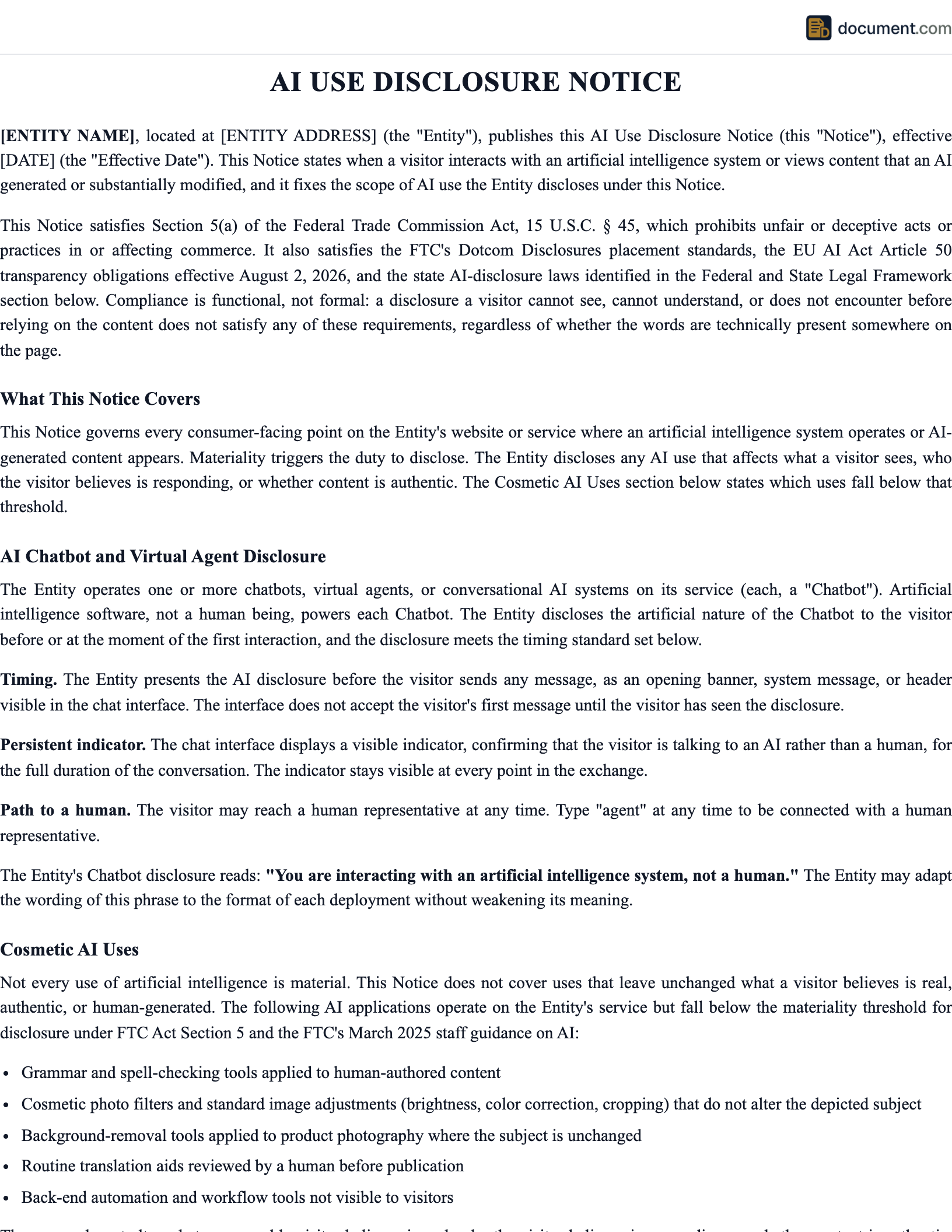
An AI Use Disclosure Notice is the "this site uses AI" disclosure that tells visitors, in plain language, when they are interacting with an artificial intelligence system or looking at content an AI generated or substantially changed. It is the public-facing transparency statement, distinct from your internal AI policy and from your privacy policy, that closes the gap between what a reasonable consumer assumes and what is actually happening on your site.
The notice does real legal work. It can appear as a banner at the top of a chat window saying you are talking to an AI assistant, a label under an image reading "AI-generated," a line in a product description noting that copy was drafted with AI, or a footer statement covering an entire site. The format follows the medium, but the function holds steady: give the visitor the fact they need before they rely on it, not after.
Underneath the words sits a second layer most people never see. Machine-readable provenance metadata, usually built on the C2PA Content Credentials standard, embeds a signed record inside the media file itself: who made it, when, which tools, and whether an AI system performed the work. Regulators increasingly expect both the visible notice and the invisible signal, and several 2026 statutes require each one separately.
This page explains who must disclose, when, and in what form, drawing on the FTC's enforcement record, the EU AI Act, and the California, New York, Utah, Maine, Colorado, and New Jersey statutes that now govern AI transparency. None of it is legal advice. AI law is moving faster than any other corner of consumer-protection law, so confirm the current text of every authority before you rely on it.
Why This Matters Now
The window between "nice to have" and "legally required" closed in 2026. Four separate effective dates land within months of each other: California SB 942 and AB 2013 on January 1, the New York synthetic-performer law on June 9, and the EU AI Act Article 50 transparency duties on August 2. If your site touches consumers in any of those jurisdictions, the question is no longer whether to disclose but how.
The FTC has stopped issuing warnings and started writing checks. Operation AI Comply, announced September 25, 2024, swept up five companies at once for using AI to supercharge deceptive conduct. The DoNotPay settlement in early 2025 carried $193,000 in monetary relief and an order barring claims that the service "operates like a human lawyer." The Air AI case settled in March 2026 on an $18 million judgment after roughly $19 million in consumer losses.
Consumers now expect the label and notice its absence. Once a few large platforms began tagging AI-generated images, an unlabeled synthetic image reads as a concealment rather than an oversight. That shift matters legally, because the FTC's deception standard turns on what a reasonable consumer would expect, and expectations have moved.
The penalty math is unforgiving. At $53,088 per violation in 2026, with each individual piece of non-compliant content counted on its own, exposure scales with your publishing volume. A modest content operation that runs AI-assisted posts at scale can build a seven-figure liability without a single complaint, simply by omitting a line of disclosure across hundreds of pages.
The Legal Backbone
FTC Act Section 5 and the deception standard
The federal backbone is not an "AI disclosure law" at all. It is Section 5(a) of the FTC Act, 15 U.S.C. section 45, which prohibits "unfair or deceptive acts or practices in or affecting commerce." The FTC's long-standing test asks whether there is a representation, omission, or practice likely to mislead a reasonable consumer about something material. Hiding the fact that a chatbot is software, or passing off an AI-generated review as a real customer's words, is a classic deceptive omission. The FTC's March 2025 staff guidance made the AI application explicit: when AI generates or substantially modifies advertising content in a way that could mislead, the AI use must be disclosed. The agency also flagged a double-disclosure problem. Influencer and endorsement content that is both sponsored and AI-assisted needs two separate disclosures, one for the commercial relationship under the Endorsement Guides at 16 CFR Part 255, and one for the AI involvement.
Materiality is the on/off switch
Not every brush with AI triggers a duty. The FTC's 2025 guidance and the IAB's January 2026 risk-based framework both draw the line at materiality. Disclosure is required when AI materially affects content authenticity, identity, or representation in a way that could mislead, think prompt-generated images, synthetic personas, AI voices, or a chatbot a user might mistake for a person. Disclosure is not required for cosmetic uses: grammar and spell-checking, basic editing, routine background tools, ordinary photo filters, and clearly stylized creative where no reasonable viewer would think they were seeing reality. If you cannot articulate how the AI use could change a consumer's understanding or decision, you are probably below the threshold. When in doubt, disclose; an unnecessary label rarely creates liability, while a missing one can.
EU AI Act Article 50: clear and distinguishable
Regulation (EU) 2024/1689, the EU AI Act, sets the most prescriptive transparency rules, with Article 50 obligations applying from August 2, 2026. For systems built for direct human interaction, providers must ensure people know they are dealing with an AI "unless this is obvious" from context. The information has to be "clear" and "distinguishable," delivered at the latest at the first interaction. Burying it in terms of service, a manual, or a layered menu does not satisfy the standard. For synthetic audio, image, video, or text, outputs must be "marked in a machine-readable format and detectable as artificially generated or manipulated," subject to technical feasibility and state-of-the-art standards. Article 50 carves out narrow exceptions: assistive editing functions, certain law-enforcement uses, satirical and artistic works (which still require disclosure but in a manner that does not spoil the work), and AI-generated text that received genuine human editorial review with identifiable editorial responsibility. The European Commission published a draft Code of Practice on AI-generated content in January 2026 to fill in the operational detail.
California SB 942 and AB 2013
California's AI Transparency Act, SB 942, took effect January 1, 2026. It binds "covered providers," defined as creators of generative AI systems with more than one million monthly users that are publicly accessible in California. Those providers must offer a free, public AI detection tool that returns provenance data and accepts URL or API input (section 22757.2), give users a visible option to add a "manifest disclosure" identifying content as AI-generated in a clear and conspicuous, hard-to-remove way (section 22757.3(a)), and embed a "latent disclosure," hidden machine-readable metadata carrying the provider name, system name and version, a creation timestamp, and a unique identifier (section 22757.3(b)). The Attorney General and local attorneys enforce it, with penalties up to $5,000 per violation per day plus fees. A separate statute, AB 2013, also effective January 1, 2026, requires generative AI developers to post a high-level summary of their training datasets, including sources, data types, and whether copyrighted or personal information was included.
The state chatbot and synthetic-performer laws
Several states regulate the live chatbot moment directly. Utah's AI Policy Act, SB 149, effective May 1, 2024 and extended through July 1, 2027, requires disclosure that a consumer is dealing with generative AI rather than a person on a clear and unambiguous request, with a safe harbor if the AI itself discloses up front and throughout. Maine's Chatbot Disclosure Act, LD 1727, effective September 16, 2025, bars using an AI chatbot in commerce in a way that misleads a consumer into thinking they are talking to a human unless a clear and conspicuous notice is given, enforced under the state's Unfair Trade Practices Act with penalties up to $1,000. New Jersey's bot-disclosure statute, N.J.S.A. 56:18-1 to 56:18-2, makes it unlawful to use a bot with intent to deceive about its artificial identity in commercial transactions, with a safe harbor for clear disclosure. New York's synthetic-performer law, S.8420-A/A.8887-B, effective June 9, 2026, requires conspicuous disclosure when an advertisement features a generative-AI "synthetic performer" and the advertiser has actual knowledge, with penalties of $1,000 for a first violation and $5,000 after. New York also enacted an AI companion-model law, effective November 5, 2025, requiring recurring disclosures and self-harm safety protocols. Colorado's original SB 24-205 was enjoined in April 2026 and replaced by SB 26-189, signed May 14, 2026, which preserves the duty to disclose interaction with consumer-facing AI.
C2PA Content Credentials: the machine-readable layer
The Coalition for Content Provenance and Authenticity, C2PA, publishes the open standard most regulators now point to for the invisible half of disclosure. Formed in 2021 from Adobe's Content Authenticity Initiative and the Microsoft/BBC Project Origin, it counts Adobe, Amazon, BBC, Google, Meta, Microsoft, OpenAI, and Sony among 200-plus members. The current specification, v2.2 from May 2025, defines a "C2PA Manifest," a digitally signed data structure embedded in the media file that records creator, timestamp, tools, edit history, and AI involvement through a "digitalSourceType" field. It supports JPEG, PNG, WebP, AVIF, HEIC, MP4, MOV, PDF, MP3, and WAV. C2PA is voluntary in the United States, but the EU AI Act's machine-readable marking requirement under Article 50 can be satisfied by a C2PA AI assertion, and California's latent-disclosure mandate aligns with the same approach. If you need your visible notice to hold up once the file leaves your site, this is the implementation detail that keeps it attached.
What goes into an AI Use Disclosure Notice
A workable notice answers three questions a visitor would reasonably ask, and it answers them in the place and the moment they matter. The first question is whether they are talking to a machine. If your site runs a chatbot, support agent, or any conversational interface backed by AI, the notice belongs at or before the first message, not three clicks deep. Utah, Maine, New Jersey, and the EU AI Act all key their requirements to that opening interaction, and the EU standard expressly rejects disclosures hidden in terms of service. A single line does it: "You are chatting with an AI assistant. Type 'agent' to reach a person."
The second question is whether the content in front of them was made or materially changed by AI. This is the labeling half of the notice. An image generated from a prompt, a product photo that an AI altered beyond cosmetic touch-up, an article drafted by a model, a voice clone, or a synthetic spokesperson all warrant a visible label using plain words. "AI-generated" tests better with consumers than "synthetic media," and the FTC's 2025 guidance points the same direction. Acceptable phrasings include "This content was created or modified by artificial intelligence" and "Generated by [Company] AI system." Place the label where the eye lands on the content, not in a distant caption block.
The third question is provenance: where did this come from, and can it be verified? Here the human-readable notice hands off to the machine-readable layer. For images, audio, and video, embedding C2PA Content Credentials gives downstream platforms, fact-checkers, and detection tools a signed record of AI involvement that survives copying and re-hosting. California's covered providers must supply both a visible manifest disclosure and a latent metadata disclosure, and the EU's marking requirement assumes a machine-readable signal. Even where neither applies to you yet, provenance metadata is what separates a label someone can strip from a claim that travels with the file.
Around those three answers, a complete notice carries the housekeeping that makes it enforceable and honest: the identity of the entity making the disclosure, the date or version so visitors know which statement governs, the scope (does this cover the whole site, one section, or a single asset?), and an accessibility-compliant presentation, which the EU AI Act expressly requires. Keep the scope truthful. A blanket footer claiming "some content on this site may be AI-generated" is weak and arguably misleading if, in fact, your chatbot is fully automated and your product images are all synthetic. Match the disclosure to the reality, and revisit it whenever your AI footprint changes.
When You Need This
You run a customer-facing chatbot, virtual agent, or voice assistant that a visitor could mistake for a human. Utah, Maine, New Jersey, New York's companion-model law, and the EU AI Act all reach this scenario.
You publish images, video, audio, or written content that AI generated or substantially modified, and the change could affect what a reasonable person believes is real or authentic.
You advertise using a synthetic performer, an AI voice, an AI-generated endorsement, or an AI avatar, where the FTC Endorsement Guides and New York's synthetic-performer law come into play.
Your business serves users in the EU and deploys AI for direct interaction or generates synthetic content, triggering EU AI Act Article 50 from August 2, 2026.
You are a large generative-AI provider with more than one million monthly California users, subject to SB 942's detection-tool, manifest, and latent-disclosure duties and AB 2013's training-data summary.
You sell AI-powered products or services and make performance or capability claims, where overstatement is exactly what Operation AI Comply targeted and what sank DoNotPay, Evolv, and Air AI.
You want a defensible, documented transparency posture before a regulator, a class-action plaintiff, or a business partner's compliance team asks how you handle AI disclosure.
How to Fill Out AI Use Disclosure Notice ("This Site Uses AI" Disclosure)
1. Map where AI actually touches the consumer
Before drafting a word, inventory every consumer-facing point where AI operates: chatbots and support agents, generated or altered images and video, AI-drafted marketing copy and reviews, voice features, synthetic spokespeople, and AI-powered product claims. For each, write down what the AI does and what a reasonable visitor would assume if you said nothing. This map drives every later decision and is your evidence of good-faith assessment if a regulator asks.
2. Run the materiality test on each touchpoint
For each item on the map, ask whether the AI use materially affects authenticity, identity, or representation in a way that could mislead. Chatbots, prompt-generated images, synthetic personas, AI voices, and AI-generated endorsements clear the bar and need disclosure. Spell-check, grammar tools, basic cropping, routine background automation, and clearly stylized creative do not. Document the calls you make so the line you drew is defensible later.
3. Identify which laws reach you
Pin down your jurisdictional exposure. If you have EU users, Article 50 applies from August 2, 2026. If you serve California consumers, check whether you hit SB 942's one-million-user threshold and whether AB 2013's training-data rule applies. Note the chatbot-specific duties in Utah, Maine, and New Jersey, the synthetic-performer rule in New York from June 9, 2026, and any political-advertising AI rules in states like Florida, Washington, and Michigan if you run political content. The strictest applicable law sets your floor.
4. Choose the format for each disclosure
Match the medium. For chat interfaces, use a banner or opening message that appears at or before the first interaction, with a clear path to a human. For static AI-generated media, use a visible label adjacent to the asset. For site-wide coverage, use a footer or dedicated notice page, but only as a supplement, never as a substitute for in-context disclosure where the law requires it. Avoid putting any required disclosure solely inside terms of service or a buried menu; the EU AI Act and the state chatbot laws specifically reject that.
5. Write the disclosure in plain, specific language
Draft the actual text. Use "AI-generated," "You are interacting with an artificial intelligence system," "This content was created or modified by artificial intelligence," or "Generated by [Company] AI system." Avoid hedging language that understates a fully automated reality. State the entity making the disclosure, the scope of what it covers, and a date or version number. Confirm the presentation meets accessibility standards (contrast, screen-reader compatibility), which the EU AI Act expressly requires.
6. Add the machine-readable provenance layer
For images, audio, and video, embed C2PA Content Credentials so the AI-involvement signal travels with the file. This means a signed manifest with the digitalSourceType field set to reflect AI or ML involvement. California covered providers must add the latent metadata disclosure (provider name, system name and version, timestamp, unique identifier) and ensure their detection tool can read it. Even where not yet mandatory for you, provenance metadata makes your visible notice durable against copying and re-hosting.
7. Coordinate with your other policies and contracts
Make sure the disclosure does not contradict your privacy policy, terms of use, or internal AI use policy. If AI training on user data is involved, your privacy policy must cover retention and opt-out. If endorsements are AI-assisted, line up the double disclosure (commercial relationship plus AI involvement) the FTC requires. Where vendors supply your AI, your contracts should allocate who is responsible for marking and disclosure, especially under Article 50, which splits duties between providers and deployers.
8. Publish, log, and schedule a review
Deploy the notice, then keep a dated record of where each disclosure appears and which version is live, because each non-compliant page is a separate FTC violation and your log is part of your defense. Set a recurring review, at least annually and immediately whenever you add an AI feature, change vendors, or a new law takes effect. AI disclosure rules change frequently at both the state and federal level. A notice that has never been revised after publication is unlikely to reflect current requirements.
Key Terms Defined
- Manifest disclosure
- A visible, human-readable label identifying content as AI-generated, clear and conspicuous, appropriate to the medium, understandable to a reasonable person, and either permanent or extraordinarily difficult to remove. California SB 942 section 22757.3(a) requires covered providers to offer users this option.
- Latent disclosure
- Hidden, machine-readable metadata embedded in a file that records the provider name, the generative-AI system name and version, a creation or alteration timestamp, and a unique identifier. Required of California covered providers under SB 942 section 22757.3(b) and detectable by the provider's own detection tool.
- C2PA Content Credentials
- An open provenance standard from the Coalition for Content Provenance and Authenticity. A digitally signed manifest embedded in a media file records creator, timestamp, tools, edit history, and AI involvement (via the digitalSourceType field). Specification v2.2 (May 2025) supports JPEG, PNG, MP4, PDF, WAV, and more.
- Synthetic performer
- A digitally created asset built with generative AI that is intended to create the impression of a human performer who is not a recognizable, identifiable natural person. New York's S.8420-A/A.8887-B, effective June 9, 2026, requires conspicuous disclosure when an advertisement features one and the advertiser has actual knowledge.
- Material AI use
- AI involvement that affects content authenticity, identity, or representation in a way that could mislead a reasonable consumer. Materiality is the threshold that separates disclosable AI use, such as synthetic images, chatbots, and AI voices, from non-disclosable cosmetic use like spell-check, grammar tools, and basic photo filters.
- Double disclosure
- The FTC's requirement that endorsement or influencer content which is both commercially sponsored and AI-assisted carry two separate disclosures: one for the commercial relationship under the Endorsement Guides (16 CFR Part 255), such as #ad, and one for the AI involvement, such as 'AI-generated.'
Related Documents
AI Use Disclosure Notice
Public-facing transparency statement telling visitors when they are interacting with AI or viewing AI-generated content. Driven by FTC Section 5, EU AI Act Article 50, and state chatbot and synthetic-content laws. This is the consumer-facing label, banner, or notice page, not an internal governance document.
Workplace AI Use Policy
Internal, employee-facing governance document covering approved AI tools, prohibited data, output verification, and ownership of AI-assisted work. Where the disclosure notice faces the public, the workplace policy faces your team and protects trade secrets and confidentiality. The two work together but speak to different audiences.
Website Privacy Policy
Governs how you collect, use, retain, and share personal data, including whether user inputs train an AI model and how users opt out. The disclosure notice flags that AI is in use; the privacy policy explains the data consequences. Required content overlaps when AI training on user data is involved, but the legal drivers (CCPA, GDPR) differ.
Website Terms of Use
The binding contract between you and your visitors, covering acceptable use, liability limits, and dispute terms. Putting a required AI disclosure only here fails the EU AI Act and state chatbot laws, which reject disclosures buried in terms. Terms can reference AI use, but they cannot substitute for an in-context, clear-and-conspicuous notice.
AI Voice & Likeness Release
A consent document used when AI generates or clones a real person's voice or likeness. It secures the rights you need before creating synthetic content. The disclosure notice then handles the downstream duty: telling the audience that what they are seeing or hearing is AI-generated. One grants the right to make it; the other discloses that you did.
AI Likeness Takedown Notice
A demand sent to remove unauthorized AI-generated depictions of a person. It is the enforcement tool used when someone else creates synthetic content without consent. Where the disclosure notice is a proactive transparency measure for your own content, the takedown notice is a reactive remedy against another party's misuse of a likeness.
Legal Authorities & Sources
This page is grounded in primary law. The statutes and official resources below are the authorities behind the guidance above. Verify the current text of any statute before relying on it.
- FTC Act Section 5(a), 15 U.S.C. § 45 (Cornell LII)
- FTC Endorsement Guides, 16 CFR Part 255 (eCFR)
- FTC Artificial Intelligence Hub
- FTC DoNotPay Settlement (Feb 2025)
- FTC Operation AI Comply (Sept 2024)
- EU AI Act Article 50 (Transparency Obligations)
- California SB 942 (AI Transparency Act)
- California AB 2013 (Training Data Transparency)
- New York S.8420-A/A.8887-B (Synthetic Performers)
- Utah SB 149 (Artificial Intelligence Policy Act)
- Maine Chatbot Disclosure Act (LD 1727)
- C2PA Specification v2.2
Frequently Asked Questions
Create your AI Use Disclosure Notice ("This Site Uses AI" Disclosure) in minutes.
Answer a few questions and download a clear, attorney-drafted document that cites the controlling law and is ready to sign.